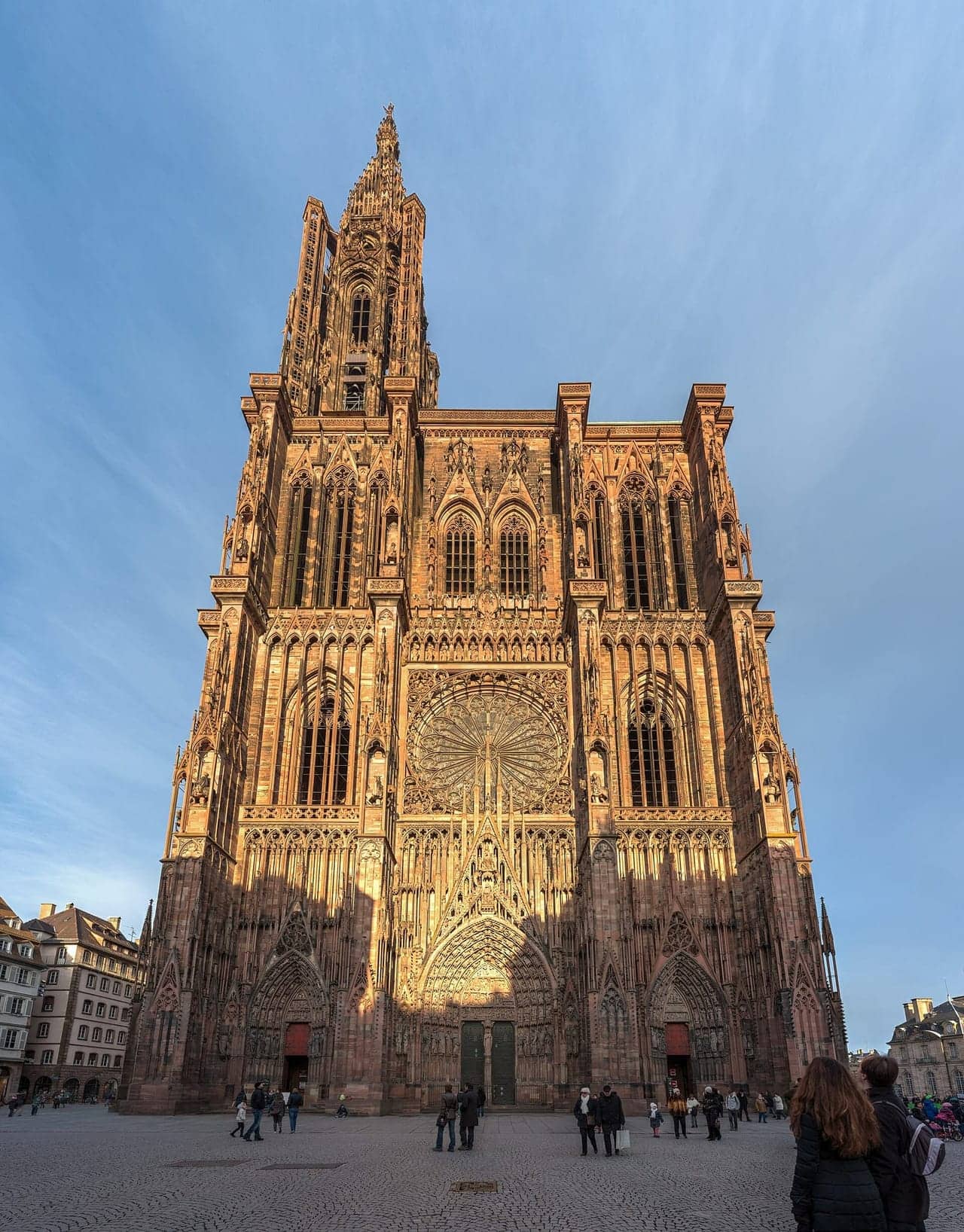
Strasbourg Cathedral (Notre-Dame)
In the heart of the Grande Île, Notre-Dame Cathedral raises its pink sandstone spire 142 metres above the square. Built in its Gothic form from the 13th century and completed in 1439, it was the tallest building in the world from 1647 to 1874. Come for the lace-like façade, the astronomical clock, the medieval stained glass and the view from the platform.
A spire that once topped the world
Erwin von Steinbach, the first architect whose name has come down to us, arrived on the site in 1284 and gave the façade its great rose window, 13.6 metres across. He died in 1318 after starting the north tower. In 1399 the city hired Ulrich von Ensingen to design the spire; Johann Hültz took over, altered the plan and finished it in 1439 at 142.11 metres. This single tower, praised by Goethe, gives the cathedral its unmistakably lopsided silhouette.
The astronomical clock and its half-past-noon parade
Standing 28 metres high in the south transept, the clock keeps the painted case of the second clock, completed in 1574 by Dasypodius, the Habrecht brothers and the painter Tobias Stimmer. From 1838 to 1843 Jean-Baptiste Schwilgué fitted a new mechanism, including an ecclesiastical computus that works out each year's movable feasts. Every day at 12.30 the apostles file past Christ while the cockerel flaps its wings and crows. The show is ticketed, with tickets sold on site on the day only, and it does not run during the Christmas market.
Stained glass, the Angels' Pillar and centuries in stone
In the north aisle, the windows of the Holy Roman emperors date from the 13th century; on the south side, 14th-century glass tells the lives of the Virgin and Christ. The choir holds a modern window donated by the Council of Europe, with the twelve stars of the European flag on blue. In the south transept, the Angels' Pillar, carved around 1230, carries twelve statues around its shaft. Handed over to Protestant worship in 1527, the cathedral returned to Catholic use after 1681.
Climbing to the platform, 66 metres up
The entrance is on Place du Château, on the right-hand side of the cathedral. A staircase of around 330 steps climbs to the platform, 66 metres above the forecourt at the foot of the spire. From up there you take in the steep roofs of the old town, the banks of the Ill and, on clear days, the Rhine plain. The tower keepers' house, restored in 2019, recalls the watchmen who once lived here. Opening times differ between summer and winter, so check the cathedral website before you go.
Practical information
Frequently asked questions
Where is Strasbourg Cathedral?
On Place de la Cathédrale, at the centre of the Grande Île, the historic core ringed by the Ill and the Faux-Rempart canal. It belongs to the UNESCO World Heritage site inscribed in 1988 and extended to the Neustadt in 2017.
Is entry to the cathedral free?
Yes, entry is free and needs no booking, with bag checks at the door. The official website gives opening times of Monday to Saturday 8.30am to 11.15am and 12.45pm to 5.45pm, and Sundays and holidays 2pm to 5.15pm. The platform and the clock show have their own arrangements.
When can I see the astronomical clock in action?
The full automaton show runs daily at 12.30, preceded by an introductory film at noon (except Sundays). Tickets are sold on site on the day and cannot be booked ahead. The show does not take place during the Christmas market.
What is there to see around the cathedral?
The Palais Rohan and its three museums stand right beside the cathedral, and the Maison Kammerzell lines the same square. Then stroll through the lanes of the Grande Île to St Thomas' Church and Petite France.
Wikimedia Commons — Diliff