Germans' Gate
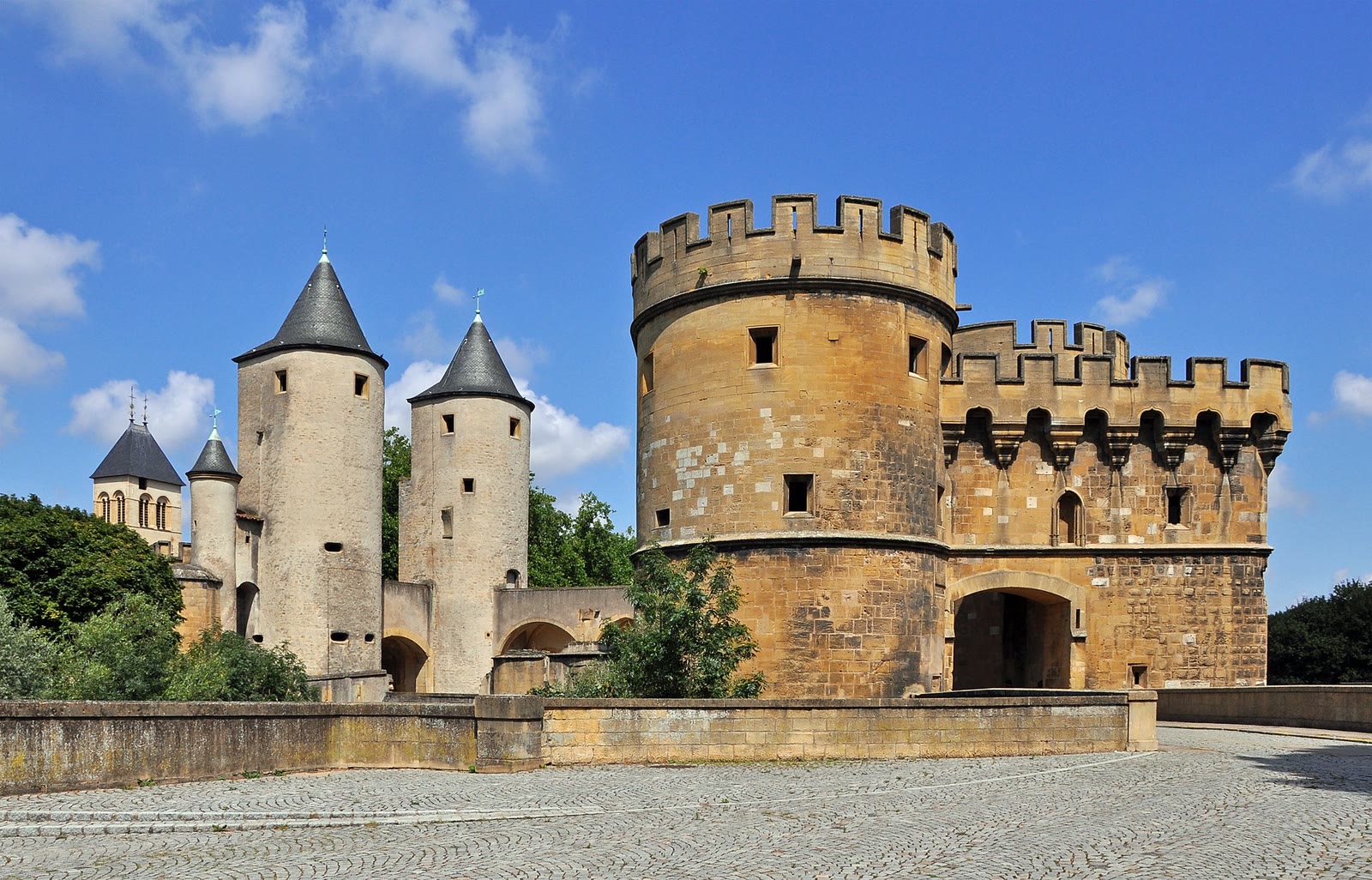
Standing at the eastern edge of the centre, the Germans' Gate straddles the Seille like a true castle. It is the last great survivor of the seventeen gates that once pierced the medieval walls of Metz. Its round towers, massive curtain walls and fortified bridge tell seven centuries of military history. Beautifully restored and now open for exhibitions, it offers a striking dive into the Middle Ages, just steps from the lively lanes of the Outre-Seille quarter.
A bridge-castle over the Seille
The Germans' Gate resembles no other city gate: it is at once a fortified passage and a bridge over the river Seille. Its towers rise nearly twenty-eight metres above the water, with walls up to three and a half metres thick, built to withstand the earliest artillery. Crossing the deck, you quickly grasp why Metz, long a free republic, was so keen to guard this eastern approach. The contrast between raw defensive power and the calm reflection of the Seille forms one of the most photographed scenes in the city.
Seven centuries of fortification
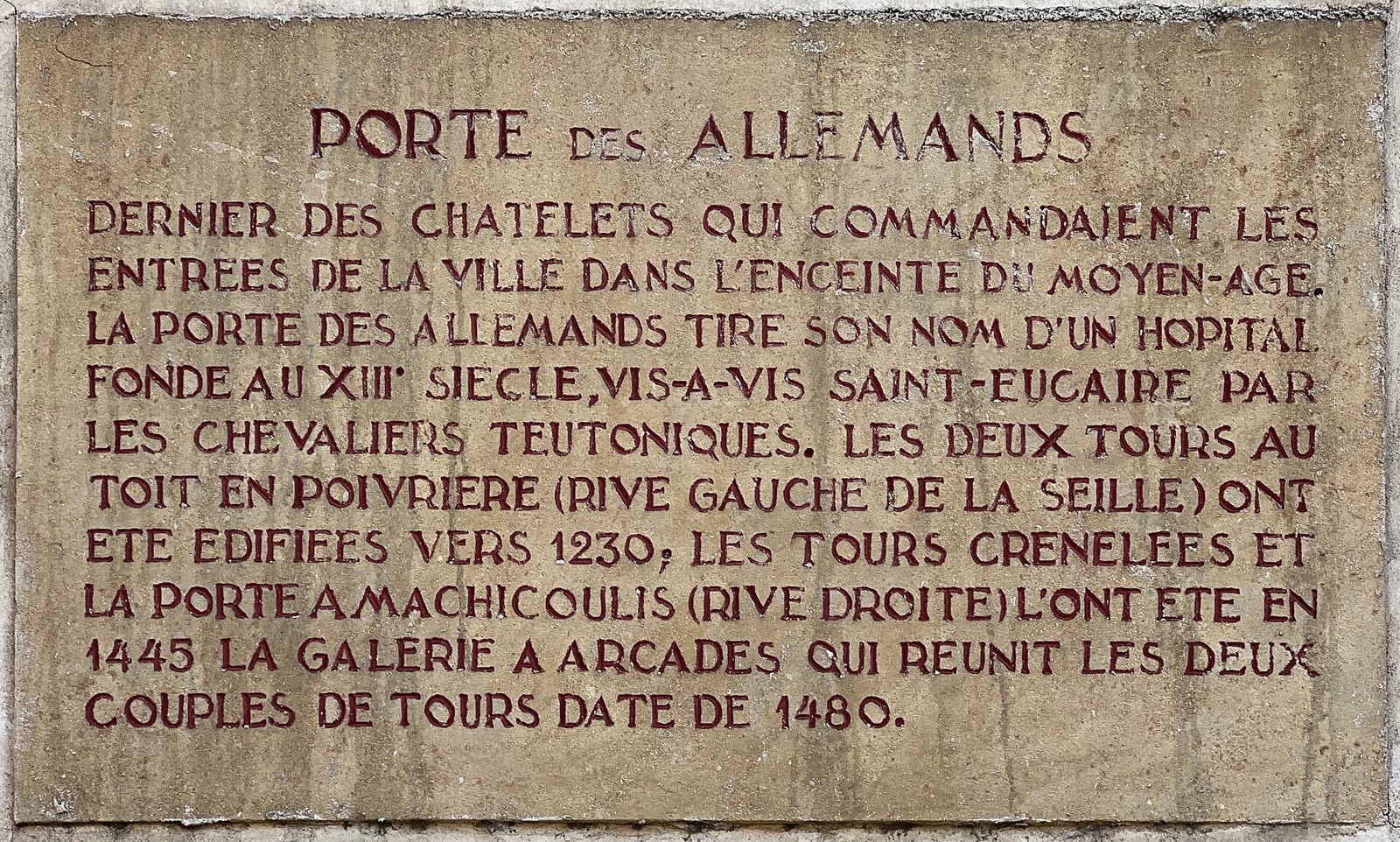
The gate's story was written in successive layers. Around 1230, two round towers linked by a pointed arch rose on the city side. In 1445 the architect Henry de Ranconval added an imposing gatehouse flanked by two large towers facing the countryside. The bridge itself was fortified between 1480 and 1550, while Philippe d'Esch was still directing works in 1529. Each era answered the advance of warfare, right up to Vauban's additions in the 17th century. A rare double-helix staircase in the north-east tower remains one of the building's best-kept secrets.
Why the name "Germans"?
The name puzzles visitors, yet it has nothing to do with any modern border. It refers to the hospital of the Brothers of Our Lady of the Germans, an institution linked to the Teutonic Order, established near here at the start of the 13th century, close to the church of Saint-Eucaire. The neighbouring gate naturally inherited the name. It is a fine example of Metz place names that preserve the memory of vanished institutions. Wandering the Outre-Seille quarter, you come across several traces of that medieval past, when brotherhoods, hospitals and guilds shaped city life.
A visit along the water
Restored during a major campaign in 2013-2014, the Germans' Gate can now be explored from the inside. A glass lift serves the terraces, where the view over the Seille and the rooftops of Metz is superb. The Renaissance halls regularly host art and heritage exhibitions, often free of charge. All around, the landscaped banks invite a stroll among willows, gardens and cycle paths. It makes an ideal starting point for walking to the cathedral or the lively Outre-Seille quarter, with its restaurants and terraces. Staying in Metz means having all of this within easy strolling distance.
Infos pratiques
Adresse : Boulevard Maginot, 57000 Metz
Questions fréquentes
Can you visit the inside of the Germans' Gate?
Yes. Since the 2013-2014 restoration, the halls and terraces have been open to the public, especially during temporary exhibitions. Opening times vary with the programme, so it is best to check the City of Metz official website before you visit.
Why is it called the "Germans' Gate"?
The name comes from a former hospital run by hospitaller brothers linked to the Teutonic Order, established nearby in the early 13th century. The neighbouring gate kept the memory alive; it is not a reference to any border.
How long should you set aside to see it?
Allow thirty to forty-five minutes to explore the halls and terraces. Extending the walk along the banks of the Seille and into the Outre-Seille quarter easily makes a pleasant one- to two-hour stroll by the water.
Is the Germans' Gate a listed monument?
Yes, it has been listed as a historical monument since 3 December 1966. It is the most important surviving relic of the medieval walls of Metz and the only large fortified gate left from the enclosure.
Wikimedia Commons — Chabe01 · Wikimedia Commons — Marc Ryckaert ( MJJR )