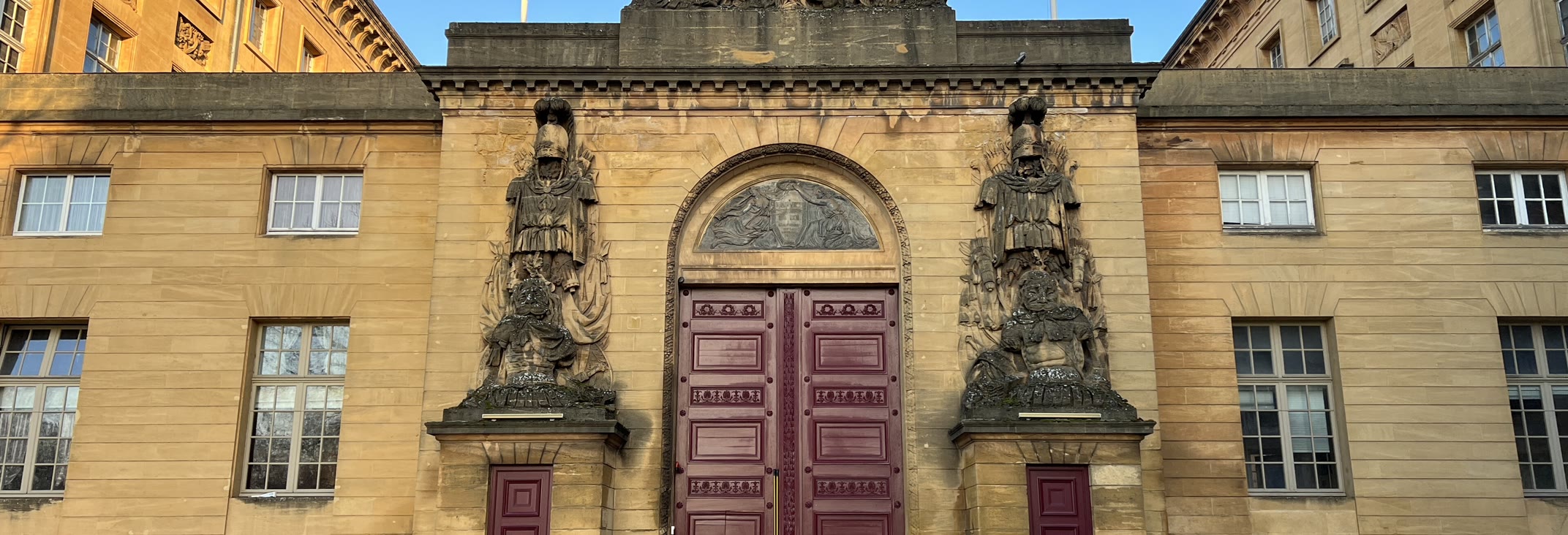
Palais de Justice (Law Courts)
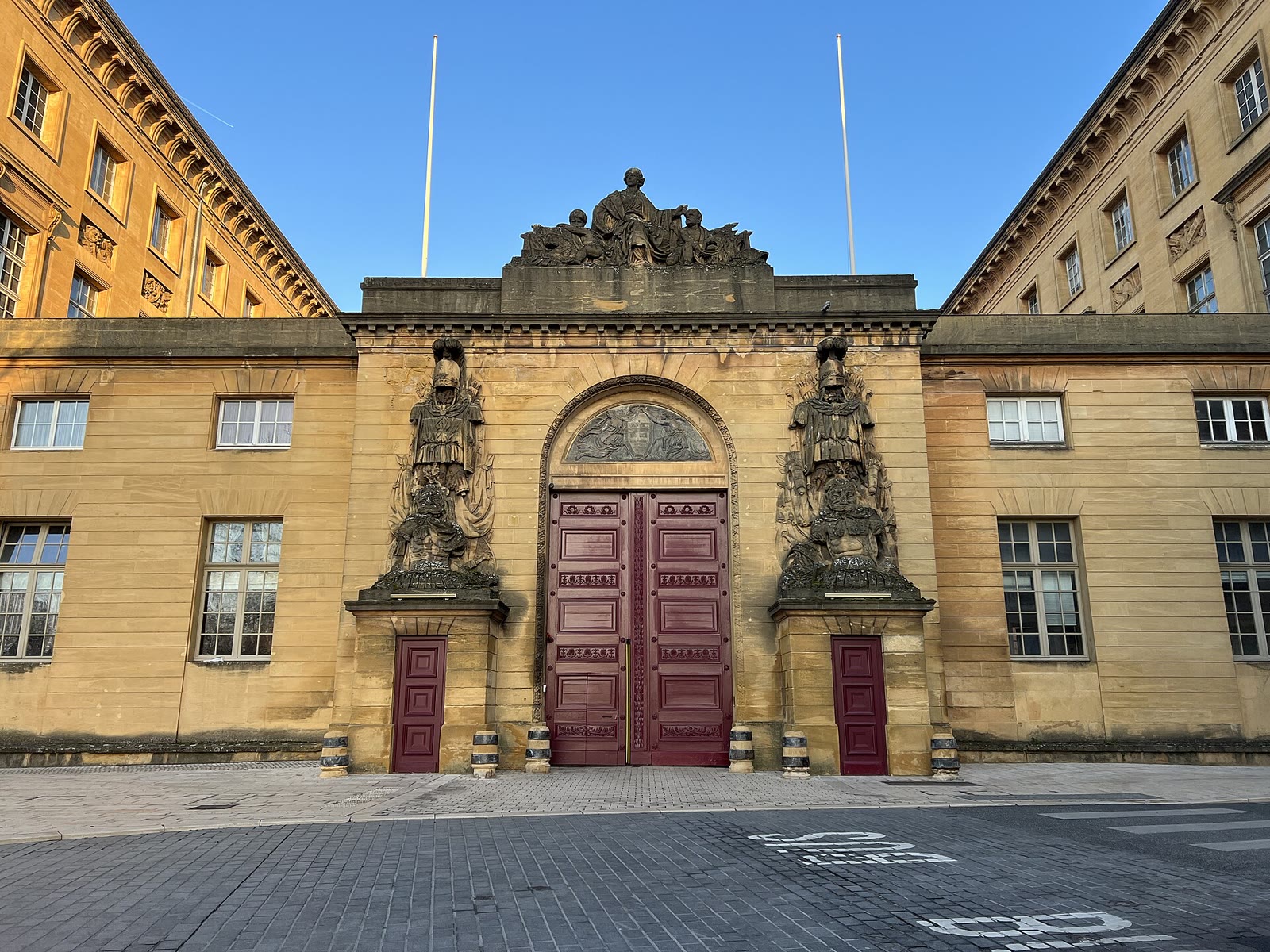
Austere and majestic, the Metz Law Courts occupy the former Palace of the Governor of the province of the Trois-Évêchés. Built in Jaumont stone on the eve of the Revolution, it displays a décor that exalts military power: trophies of arms, war deities, carved allegories. And it was from here, they say, that the young Marquis de Lafayette set out for America in 1775. An official building to admire from the outside, if you look up at its façades.
The former Governor's Palace
The building was not designed for justice, but for power. After the Trois-Évêchés — Metz, Toul and Verdun — were joined to France, the king had a palace built here to house the province's governor. Work began in 1778, on the site of the former Hôtel de Haute Pierre, which gave its name to the street. Only in 1812, under the Empire, was the building assigned to the court. To this day it houses a working jurisdiction, which explains its regulated access.
Neoclassical architecture
The palace belongs to the great neoclassical movement that reshaped Metz in the 18th century — the same that gave the city its Place d'Armes and its staged cathedral setting. Built in Jaumont stone, the golden-blonde local limestone so characteristic of the city, it is organised around a central body flanked by two lateral pavilions. The composition, symmetrical and rigorous, seeks less to charm than to command respect. This is an architecture of representation, made to embody the authority of the State in a garrison and border city.
A décor glorifying arms
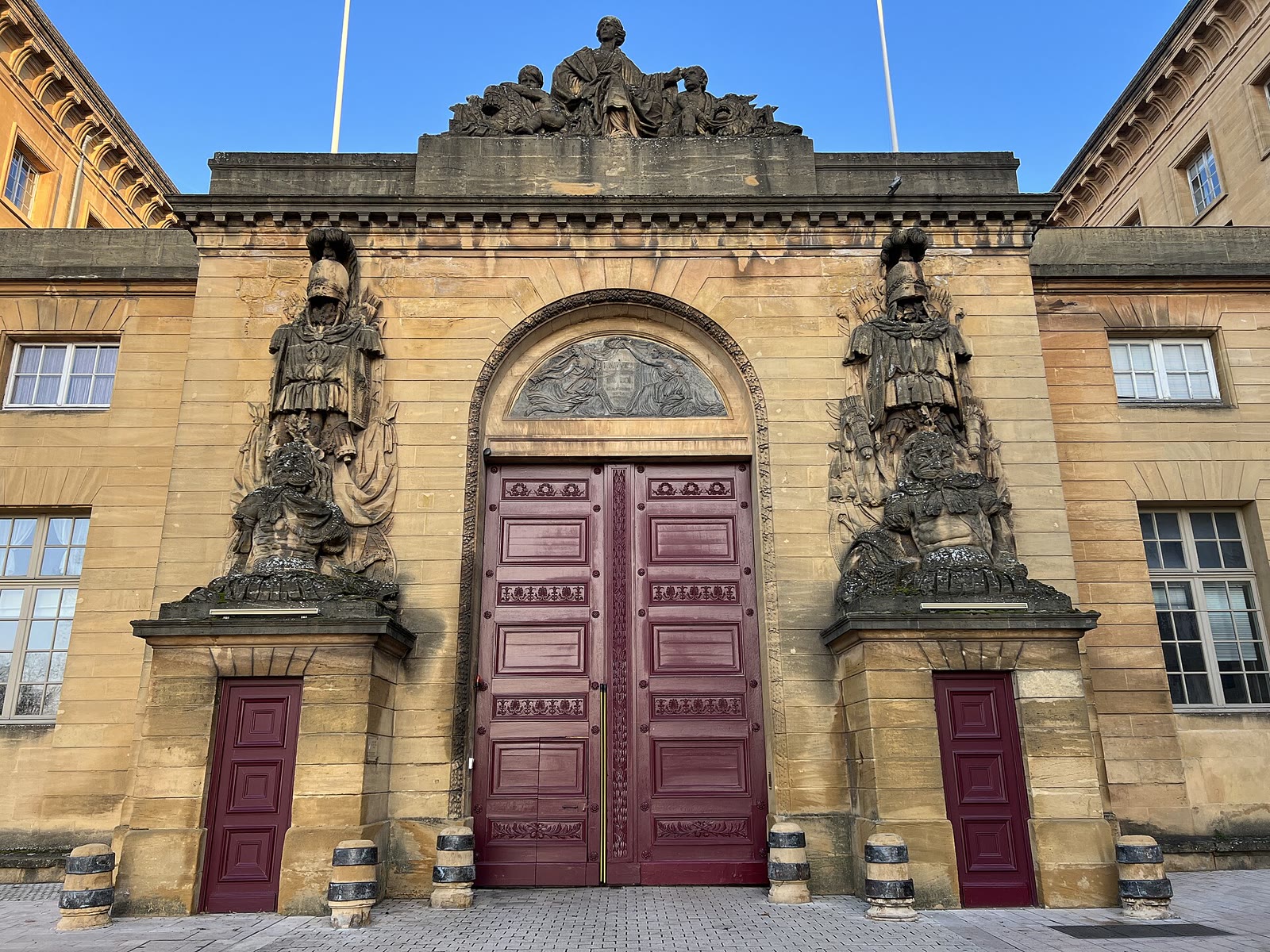
What strikes the eye are the sculptures adorning the entrance. Military trophies, panoplies of arms and allegorical figures celebrate warlike might. Among them you can make out Mars and Minerva, god and goddess of war in Roman mythology, along with an allegory of Clemency. This sculpted programme is no accidental ornament: it recalls that Metz was long a border and garrison city, the military lock of eastern France. Look up: these reliefs tell, better than any speech, the building's original purpose.
The memory of Lafayette
A page of great history was written here. It was in Metz, tradition holds, that the young Marquis de Lafayette resolved in 1775 to join the American insurgents fighting for their independence against England. His commitment across the Atlantic is even evoked by a relief on the building. The place thus links Lorraine to one of the founding episodes of the United States. One more reason to pause before these façades: behind the neoclassical rigour runs a thread reaching all the way to Yorktown and the birth of a nation.
Infos pratiques
Adresse : 3 Rue Haute Pierre, 57000 Metz
Questions fréquentes
Can you visit the Law Courts?
It is first and foremost a working courthouse, with regulated access. You can freely admire its sculpted façades from the outside. Guided tours of the interior are sometimes offered during the European Heritage Days; check with the tourist office.
Where is the Law Courts building?
At 3 rue Haute Pierre in Metz (57000), right in the city centre, a few minutes' walk from Saint-Étienne cathedral and the Place d'Armes.
What is the connection with Lafayette?
Tradition holds that it was in Metz, in 1775, that the Marquis de Lafayette decided to join the American insurgents. A relief on the building evokes his commitment to the independence of the United States.
How old is the building?
Its construction began in 1778, at the end of the Ancien Régime, as the palace of the governor of the Trois-Évêchés province. It became a courthouse only in 1812, under the First Empire.
Wikimedia Commons — Chabe01