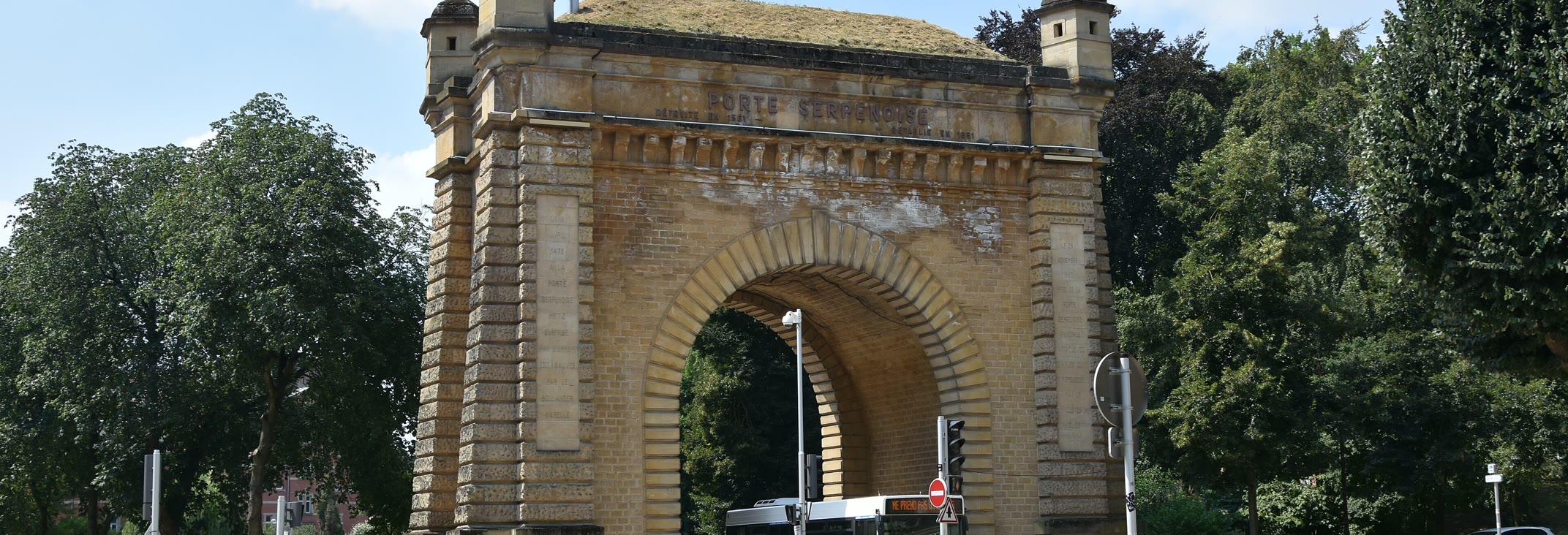
Porte Serpenoise
At the entrance to the centre of Metz, on avenue Robert Schuman, the Porte Serpenoise stands like an open-air history book. From the southern edge of the Roman city in the 3rd century to the liberation of 1918, it has witnessed sieges, resistance and liberations. Reshaped in the early 20th century into an elegant turreted arch, it remains one of the city's most symbolic monuments.
A gate laden with symbols
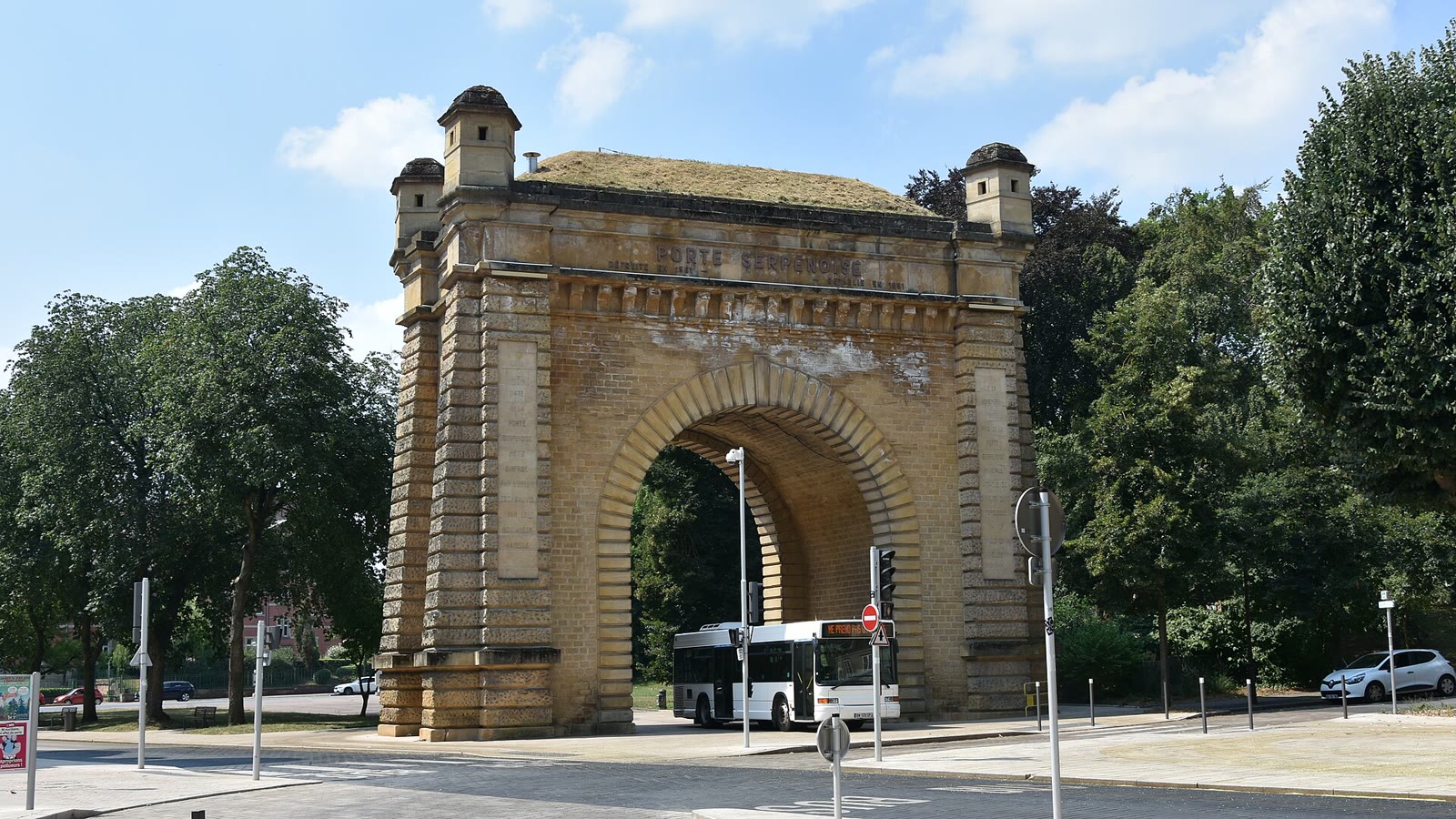
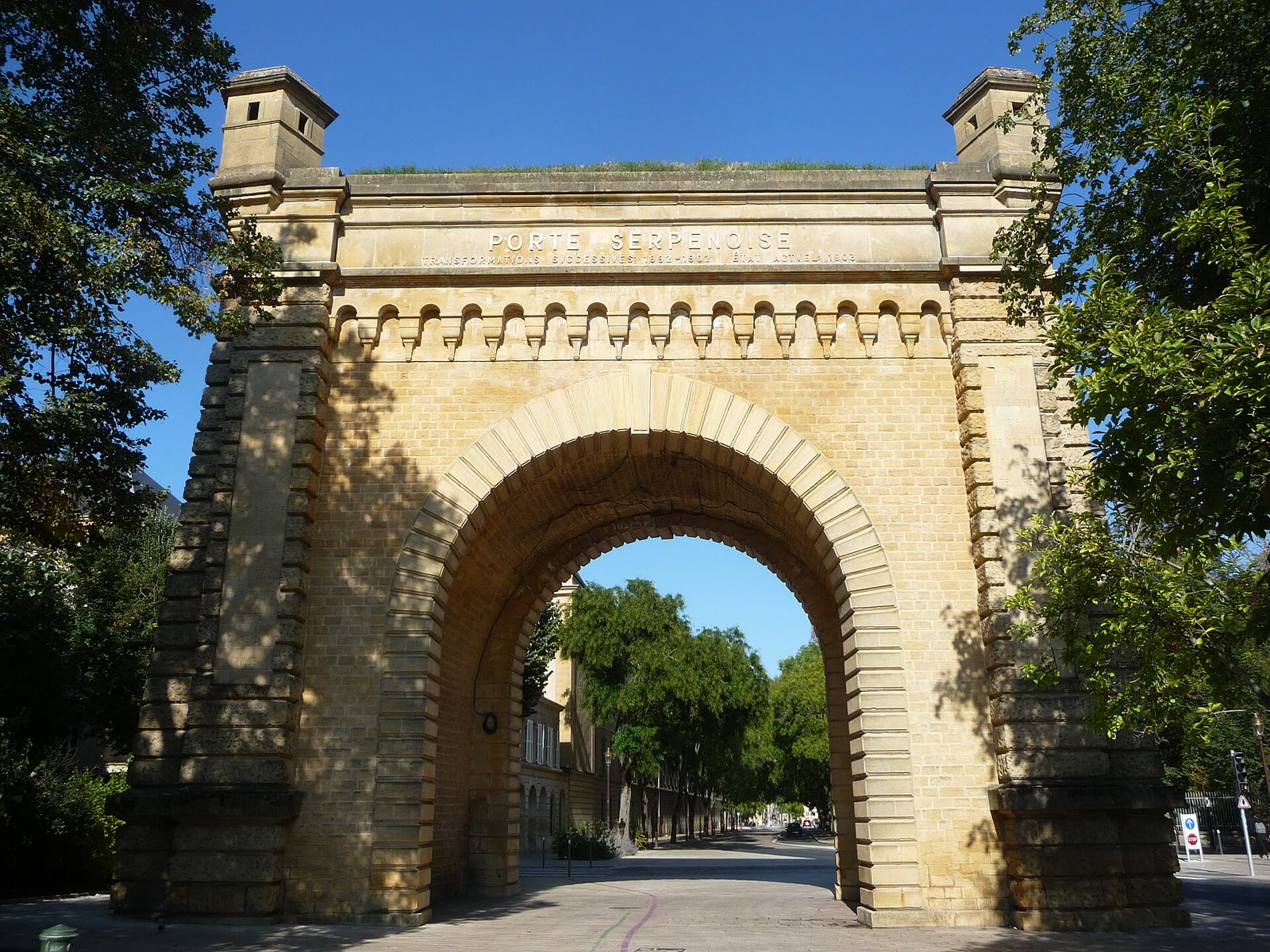
Set at the corner of avenue Robert Schuman and rue du Général Gaston-Dupuis, right at the heart of Metz-Centre, the Porte Serpenoise no longer serves any defensive role. It remains, however, a powerful symbol, tied to several major chapters of the city's history. Long the obligatory way into the city from the south, it saw soldiers, sovereigns and liberators follow one another. Now standing alone amid the boulevards, it draws the eye of passers-by and invites them to read the engraved inscriptions that recall, episode after episode, the eventful destiny of Metz.
From Roman origins to medieval ramparts
The gate's history goes back to the 3rd century, when it marked the southern edge of the Gallo-Roman city, on the line of the Roman wall. Its very name betrays ancient roots: it is said to derive from the Via Scarponensis, the road towards Scarpone, whose contraction gave "Serpenoise". In the 13th century it was rebuilt with the medieval ramparts and took the form of a vast vault pierced through the wall. For centuries it was one of the main entrances to the fortified city, controlling comings and goings and playing a leading strategic role in the defence of Metz.
The stage for Metz's great moments
Few monuments hold so much memory. In 1473 the baker Harelle is said to have raised the alarm here after spotting disguised Lorraine soldiers, saving the city from a surprise attack. In 1552 the city withstood the famous siege by Charles V, led by the Duke of Guise. In 1870, after the defeat at Sedan, Prussian troops passed through the gate. Finally, on 19 November 1918, French troops made a triumphal entry, marking the return of Metz to France. So many episodes recalled by the inscriptions engraved on the monument, a true digest of the city's history.
A gate turned into a monumental arch
The gate's present appearance dates from the early 20th century. In 1902-1903 the dismantling of the urban fortifications led to a thorough reworking: the German authorities reduced it to about a quarter of its original size and crowned it with four corner turrets taken from the old fortifications. It then took on the look of a triumphal arch, standing alone and decorative rather than defensive. It is this elegant outline, blending old stones and careful reassembly, that we admire today. Far from frozen, the Porte Serpenoise thus tells, in its very form, the successive metamorphoses of a border city fought over many times.
Discovering the Porte Serpenoise and staying in Metz
The Porte Serpenoise can be seen freely at any hour, on a walk through the centre. It stands a stone's throw from Metz's grand railway station, the imperial quarter and place de la République: an ideal starting point for exploring the city on foot. Taking time to walk around it, decipher its inscriptions and picture the scenes it has witnessed adds a living dimension to the visit. Staying in Metz in a central apartment lets you cross this monument daily and reach the cathedral, the Moselle and the city's other treasures with ease.
Infos pratiques
Adresse : Avenue Robert Schuman, 57000 Metz
Questions fréquentes
Why is the Porte Serpenoise famous?
Because it is the symbolic witness of many episodes in Metz's history, from the southern edge of the Roman city to medieval sieges and the liberation of the city in 1918.
Where does the name "Serpenoise" come from?
It is thought to derive from the Via Scarponensis, the Roman road towards Scarpone. By contraction, "Scarponensis" is said to have become "Serpenoise", recalling the age of the site.
Can you visit the Porte Serpenoise?
It is an outdoor monument, freely visible at any time. You can walk around it and read the engraved inscriptions, with no opening hours or ticket.
Why is its present form so distinctive?
In 1902-1903, during the dismantling of the fortifications, the German authorities reduced it to about a quarter of its size and crowned it with four corner turrets, giving it its monumental-arch look.
Where is the Porte Serpenoise?
On avenue Robert Schuman, at the corner of rue du Général Gaston-Dupuis, in the Metz-Centre district, a few minutes' walk from the station and the historic centre.
Wikimedia Commons — Paul Hermans · Wikimedia Commons — Immanuel Giel