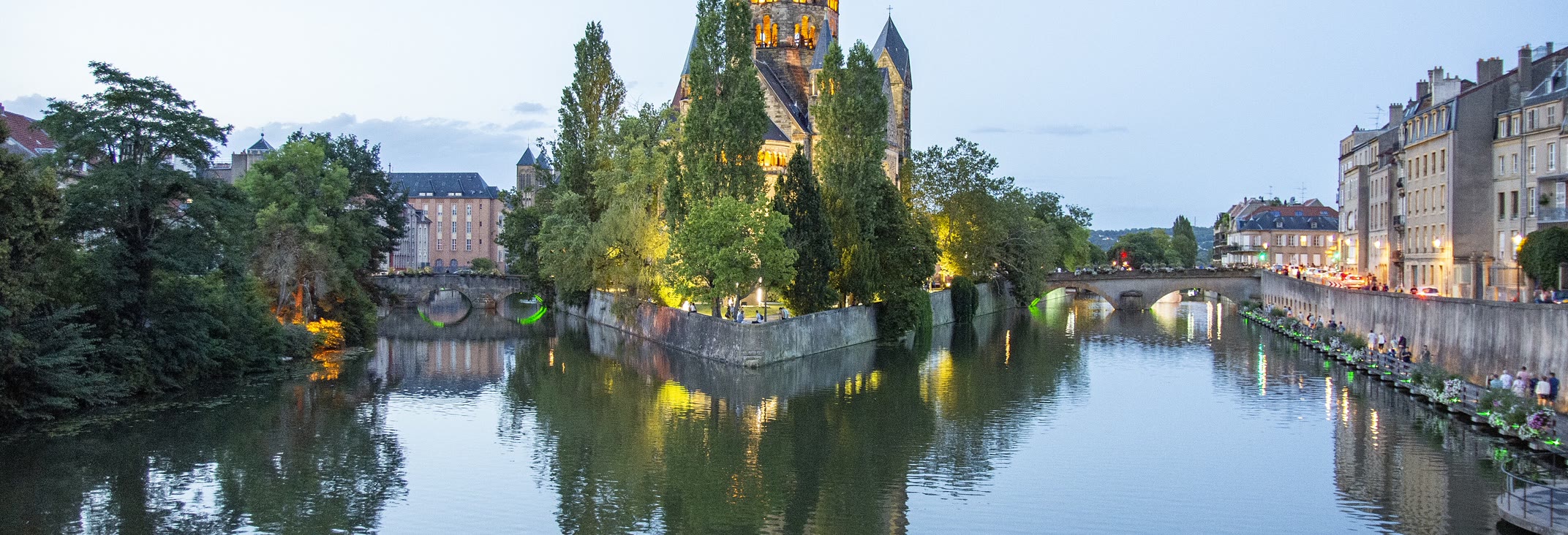
Temple Neuf, Metz
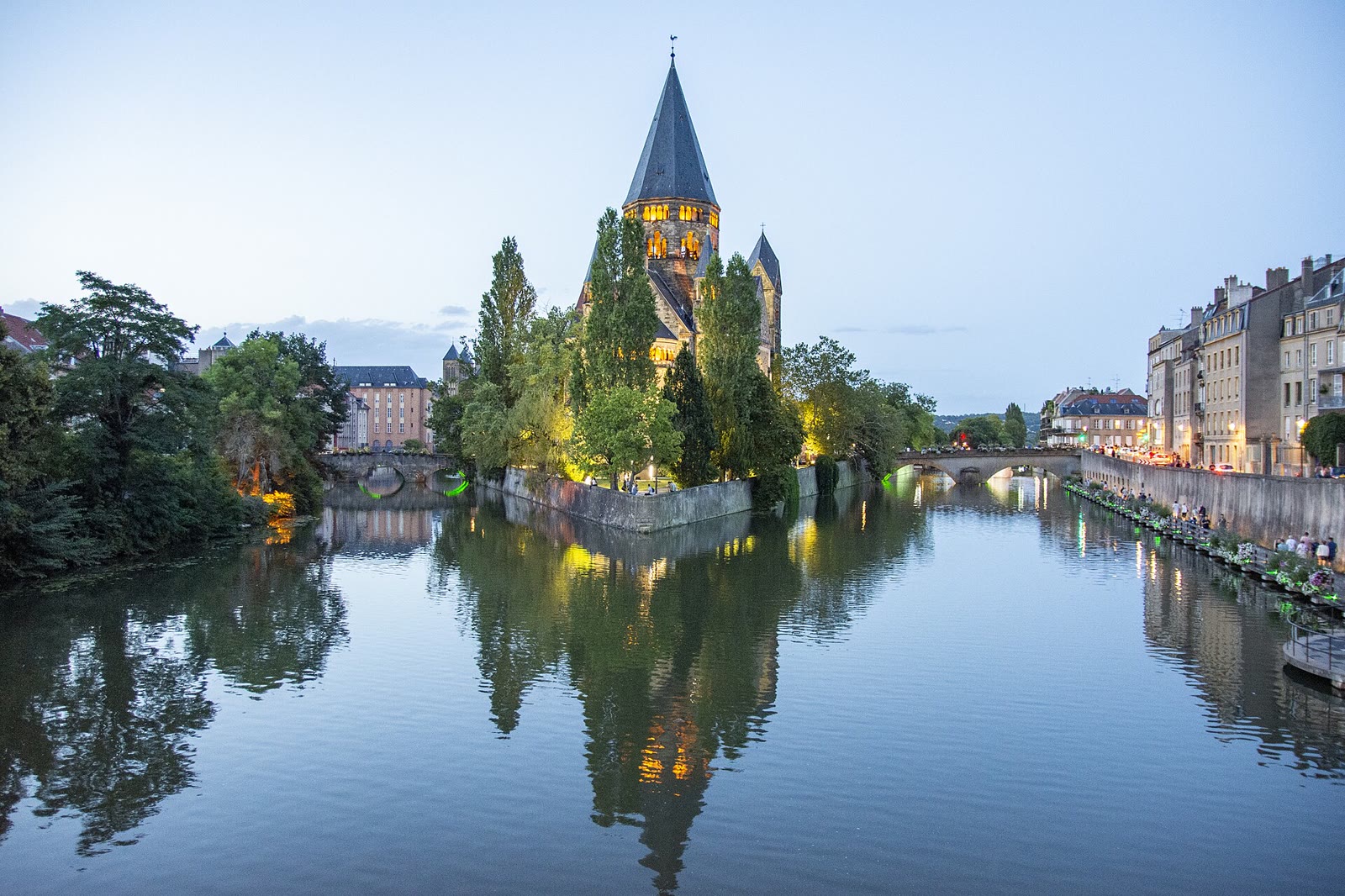
Rising on an island in the Moselle, at the tip of the Petit-Saulcy, the Temple Neuf is one of the most photographed monuments in Metz. This Protestant church in the neo-Romanesque style, built between 1901 and 1905 during the German period, mirrors itself in the calm waters of the pond, offering a postcard image. Its dark-sandstone outline watches over place de la Comédie and the jardin d'Amour.
A romantic silhouette on the Moselle
Few views sum up Metz as well as that of the Temple Neuf set at the water's edge. Built at the south-western tip of the Petit-Saulcy island, ringed by the Moselle, it stands on the site of the former jardin d'Amour, a willow grove ceded by the City in the late 19th century. From place de la Comédie or the neighbouring banks, its dark-sandstone mass reflects in the pond, especially in the golden evening light. This romantic setting, among trees, bridges and classical façades, makes it one of the favourite spots of strollers and photographers.
A church of the German imperial era
The Temple Neuf was born during the German annexation, when Metz belonged to the Reichsland of Alsace-Lorraine. The first stone was laid in November 1901 by the Statthalter, and the building was inaugurated on 14 May 1904 in the presence of Emperor Wilhelm II himself. Intended for the Reformed Protestant community, it also asserted, through its scale and Germanic style, the imperial presence at the city's heart. Now a member of the Union of Protestant Churches of Alsace and Lorraine, the parish carries on this vocation. The monument thus bears witness to a singular chapter of Metz's history, at the crossroads of French and German influences.
Conrad Wahn's Rhenish neo-Romanesque art
Designed by architect Conrad Wahn, the Temple Neuf belongs to the Rhenish neo-Romanesque tradition, widely inspired by the great imperial cathedrals of Speyer and Mainz. Built of dark sandstone, it unfolds a Greek-cross plan about 53 metres long. Its octagonal lantern tower, at the transept crossing, rises to some fifty metres, while two bell towers frame the façade and the chevet is adorned with a gallery of slender columns. The decorative vocabulary, with Ottonian-inspired capitals, gives the building a powerful, solemn medieval air, perfectly matched to its island setting.
Inside: light and music
The interior, plain and bright as befits a Reformed church, could originally hold more than twelve hundred worshippers. The ample, clear space highlights the structure and leaves room for the word and for song. The church houses a fine organ built by the Dalstein-Haerpfer makers in 1903, with around fifty stops and restored over time. Thanks to this instrument and its acoustics, the Temple Neuf regularly hosts concerts and recitals, notably linked to the conservatory. It is the ideal chance to discover the building in a different light, carried by music.
Admiring the Temple Neuf and staying in Metz
To grasp all the magic of the Temple Neuf, nothing beats a walk around the pond at dusk, when the façade lights up and mirrors in the Moselle. The monument can be visited freely according to service times and during concerts. It stands a few steps from the theatre and place de la Comédie, at the heart of a district ideal for strolling. Staying in Metz, in a well-placed apartment, lets you enjoy these moods at any hour, come back to photograph the church at early morning and reach the cathedral and historic centre on foot.
Infos pratiques
Adresse : 1 Place de la Comédie, 57000 Metz
Questions fréquentes
Why is the Temple Neuf so iconic?
Because of its unique setting on an island in the Moselle: its dark-sandstone outline reflects in the pond and makes one of the most photographed views of Metz, especially at sunset.
What faith does the Temple Neuf belong to?
It is a Reformed Protestant church. The parish is now a member of the Union of Protestant Churches of Alsace and Lorraine.
Who built the Temple Neuf and when?
Architect Conrad Wahn, between 1901 and 1905, during the German period. The building was inaugurated on 14 May 1904 in the presence of Emperor Wilhelm II.
Can you visit the Temple Neuf?
Yes, entry is free according to service times and during the concerts held there regularly. Exact times should be checked with the parish or the tourist office.
Where is the Temple Neuf?
On place de la Comédie, on the Petit-Saulcy island, encircled by the Moselle, a few minutes' walk from the historic centre and Saint-Étienne cathedral.
Wikimedia Commons — Chrysanthi Kostidi · Wikimedia Commons — Flocci Nivis