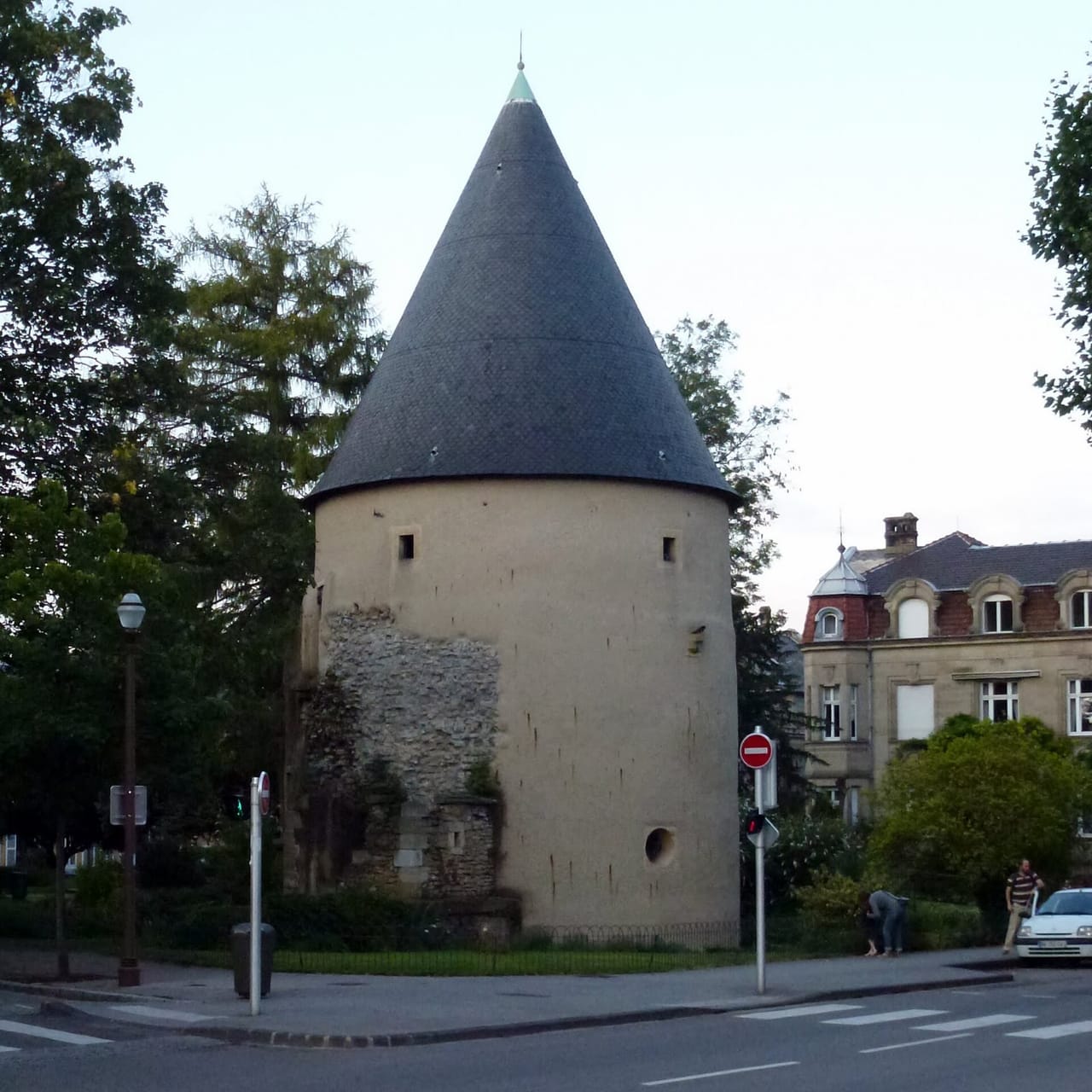
Tour Camoufle, a remnant of Metz's medieval walls
The Tour Camoufle is a remnant of Metz's old medieval walls. Few of the towers on these ramparts have survived to the present day, and this is one of them.
Jacob de Castel, the gunner whose nickname stuck to the tower
The tower has not always gone by this name. According to Wikipedia, it was first known as the tour du Champ à Panne, before taking the nickname of Jacob de Castel, called Camoufle, a 15th-century Metz gunner famed for his accuracy. His skill was such that he was suspected of a pact with the devil, a tale that belongs to legend. The Metz tourist office remembers him as a master gunner and a brave soldier who is said to have saved the city several times. Many towers in Metz were named after a trade; this one keeps the memory of a man.
A tower built for cannon and scarred by sieges
Cylindrical and set at the corner of the old rampart, the Camoufle Tower is described by the tourist office as a 15th-century artillery tower. Wikipedia dates the start of work to 1437, during a strengthening of the walls, on the site of an earlier Gallo-Roman tower between the Porte Serpenoise and the Porte Saint-Thiébault. It kept its defensive role until Charles V besieged the city in 1552. The same source links the cannonball marks on its stonework, probably, to the sieges of 1444 and 1552. Take a close look at the masonry: that is where this history is easiest to read.
Why the tower seems sunk into the ground
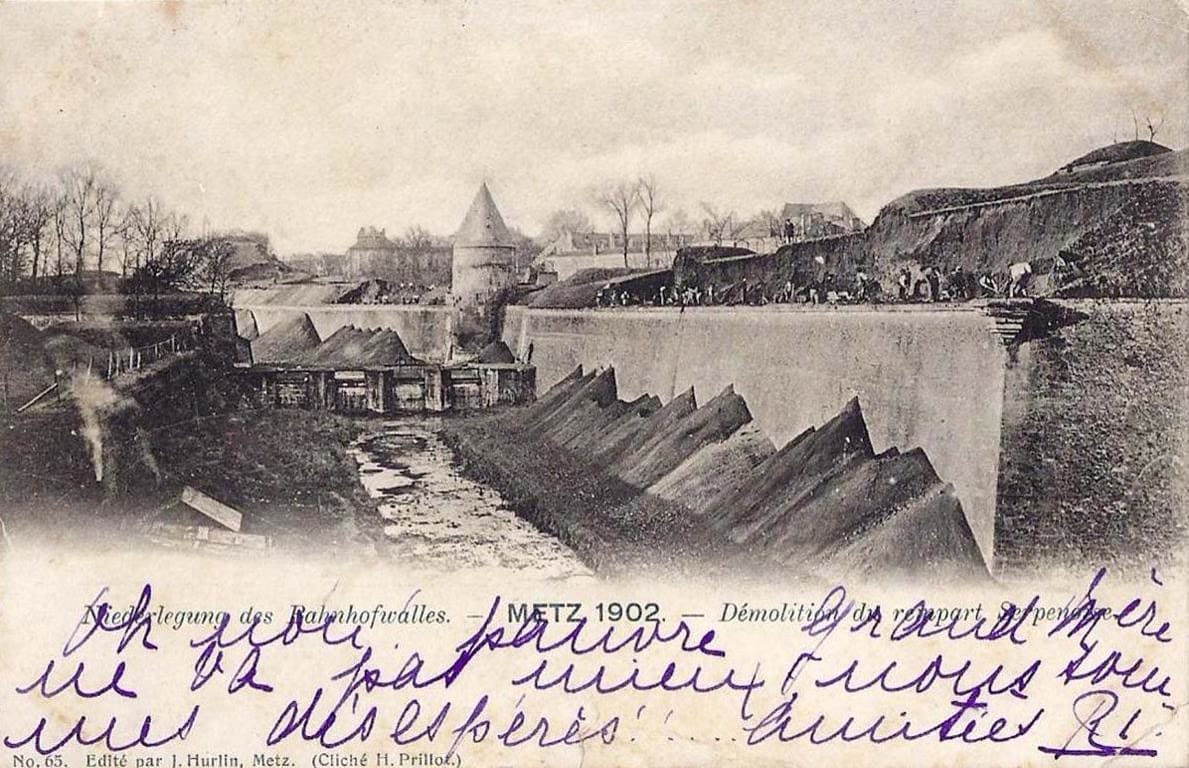
Today's outline is misleading about the original height. In 1732 the engineer Cormontaigne laid out the new Saint-Thiébault rampart and kept the tower, which advances in artillery would gradually make obsolete. The big change came with the imperial quarter: in 1903, according to Wikipedia, the moat was filled in to create the avenue Foch, and more than half of the structure vanished under the backfill. What you see today is therefore only part of the tower. The dismantling of the fortifications swept away the neighbouring walls, so that it now marks, amid early 20th-century surroundings, the line of the old city wall.
See it in the Square Camoufle, then carry on to the Seille
The tower can only be seen from outside: the tourist office lists it as a free, exterior-only visit, from the Square Camoufle. Think of it as a short stop rather than a full visit. Do not confuse it with the stretch of medieval wall still standing along the Seille and the Moselle, on the far side of the centre, between the Porte des Allemands and the Pont des Grilles. This lone tower and that long line of wall belonged to the same defensive system, which reached about 5,500 metres by the end of the Middle Ages. Seeing both in a day on foot gives a good idea of its scale.
Practical information
Address: Square Camoufle, avenue Foch, 57000 Metz
Frequently asked questions
Is this monument protected?
Yes, it has been listed as a historic monument (inscrit) since 1929.
Can you visit the Camoufle Tower?
Only from the outside. The Metz tourist office lists it as a free, exterior-only visit: from the Square Camoufle, you can take in its cylindrical shape and the stonework marked by past sieges.
Where should you stay to reach the Camoufle Tower on foot?
The Imperial Quarter, near the station, is the most convenient, since the tower stands there. To compare it with the centre or Outre-Seille and look for accommodation, see Staylaro's guide “Se loger à Metz”.
How do you get to the Camoufle Tower?
On foot, by heading for the avenue Foch in the Imperial Quarter: the tower stands in the Square Camoufle. The Porte Serpenoise, another landmark of the old walls on this side of town, rounds off the walk.
Wikimedia Commons — Anonyme · Wikimedia Commons — Николай Максимович