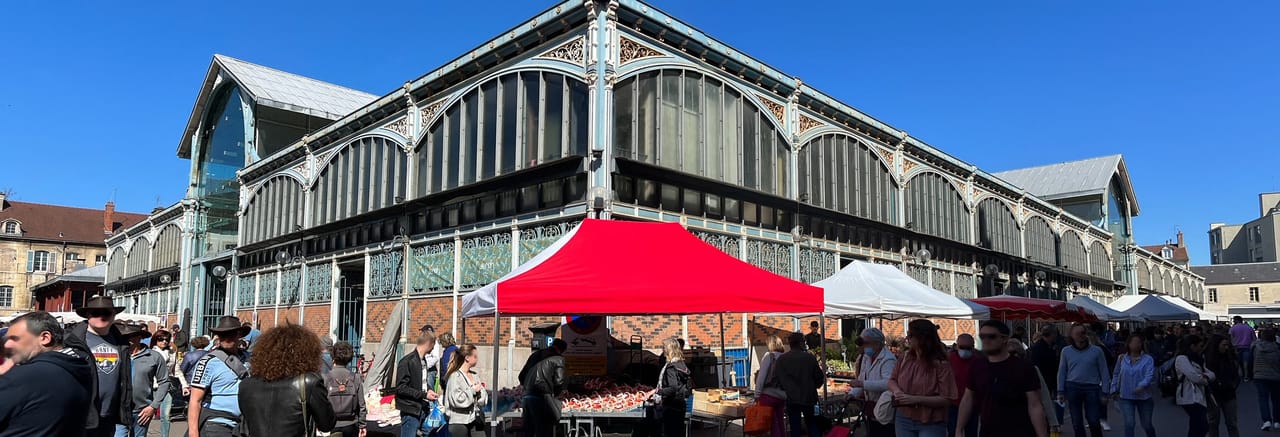
Halles centrales de Dijon
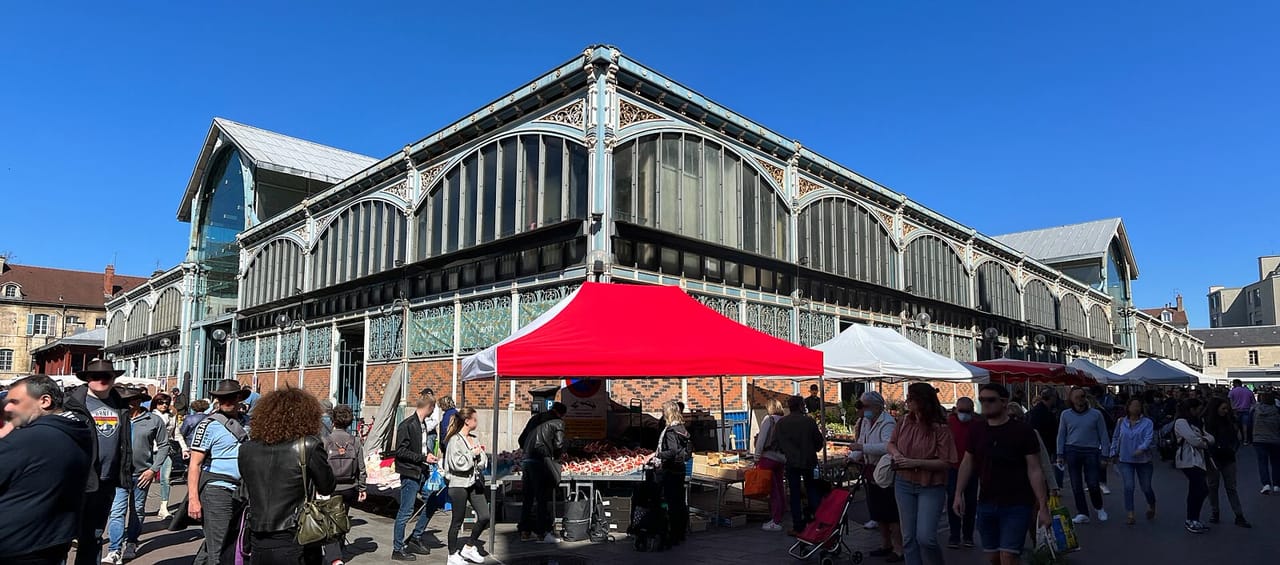
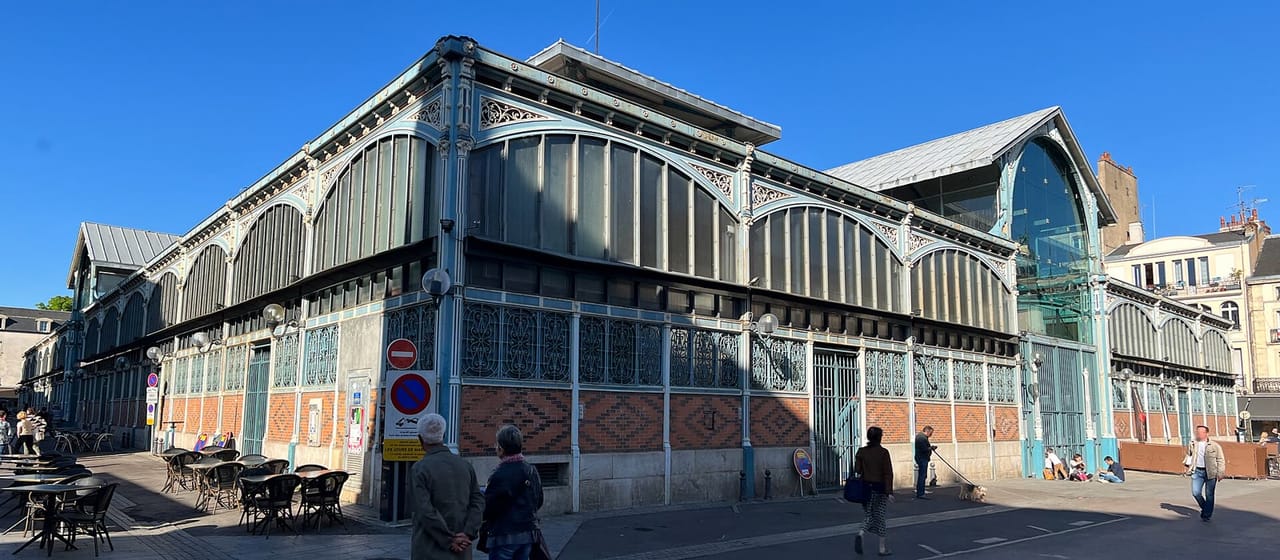
Dijon's central market hall is a large covered market with a metal frame, built between 1873 and 1875 in the heart of the historic centre. A listed monument since 1975, it gathers producers, butchers, cheesemongers and fishmongers under a glass roof. People come for the atmosphere and the produce of Burgundy.
From the Jacobins convent to an iron market
The city decided to build in 1868; plans begun by the municipal architect F. Gouet were completed in 1869 by the engineer Louis-Clément Weinberger. The hall stands on the site of the former Jacobins convent, with its 13th-century church. The metal framework was made by the Fonderies et ateliers de construction de Fourchambault.
Under the glass roof, vine leaves and medallions
The building belongs to 19th-century metal architecture, yet it is not bare: capitals decorated with vine leaves, animal motifs, medallions of Ceres and Hermes. A roof topped by a lantern lets light in. A nod to the vine and to trade, two pillars of the city.
Shopping or simply browsing
Producers' and traders' stalls offer fresh produce, meats, cheeses and Burgundy specialities. The market is liveliest in the morning on several days of the week; the rhythm shifts with the season, so check with the tourist office before you go. Even without buying anything, a loop under the hall is worth the detour.
Pairing it with the old town
The hall is framed by rues Quentin, Odebert and Bannelier, a few minutes from Notre-Dame church and rue des Forges. After the market, a stroll towards the town mansions of the centre naturally extends the morning. Cafés nearby let you sit down with your purchases in mind.
Practical information
Address: Rue Quentin, Rue Odebert, Rue Bannelier, 21000 Dijon
Frequently asked questions
Where is Dijon's market hall?
In central Dijon, between rues Quentin, Odebert and Bannelier, a few minutes' walk from Notre-Dame church.
Why is the market hall notable?
It is a 19th-century metal-framed hall (1873-1875), a listed monument since 1975, that still works as a market.
When is it best to go?
In the morning, when stalls are full and the atmosphere lively. Check opening days with the tourist office.
What should it be combined with?
With Notre-Dame church and its owl, rue des Forges and the town mansions of the old centre.
Wikimedia Commons — Chabe01