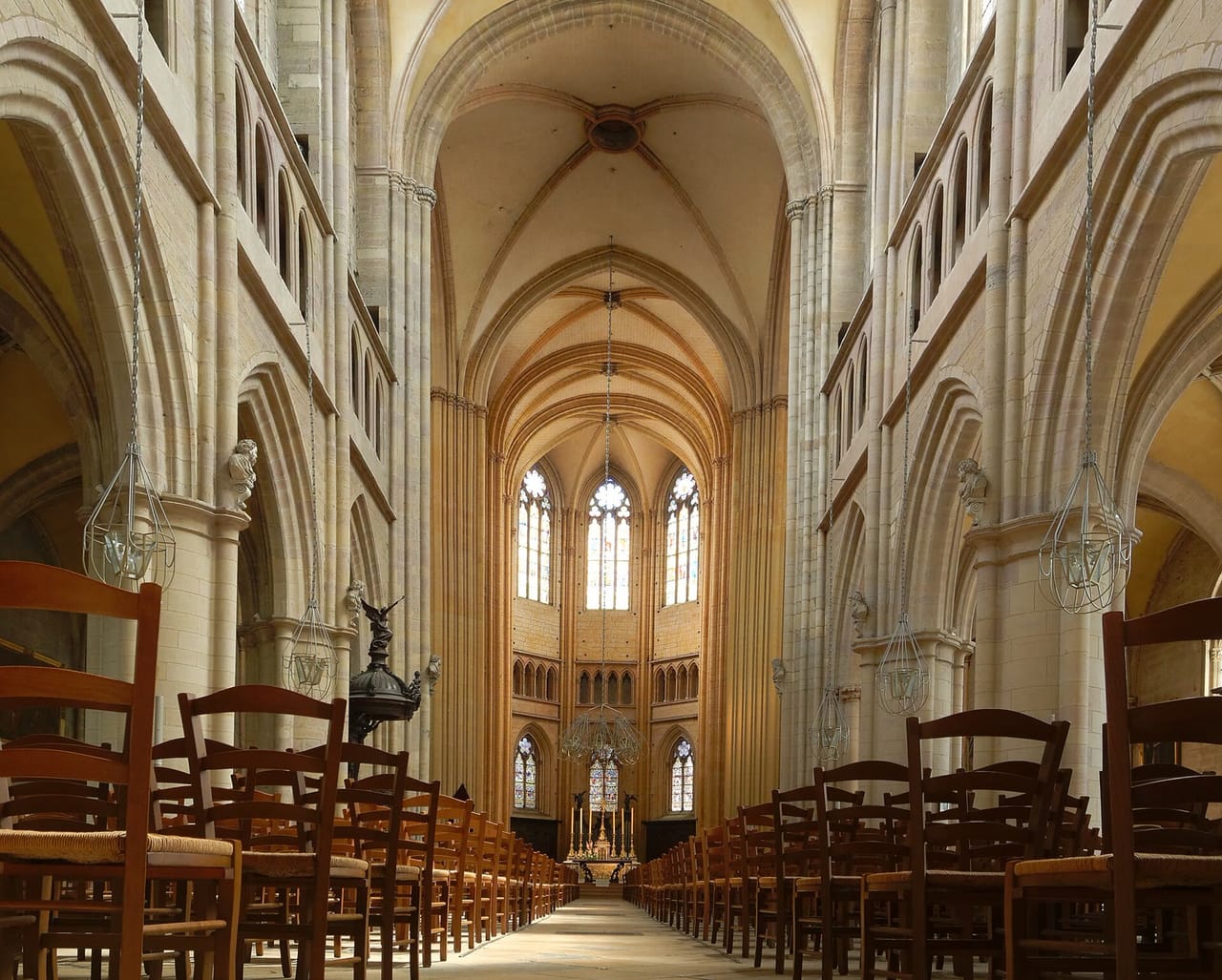
Saint-Bénigne Cathedral, Dijon
Saint-Bénigne Cathedral stands on Place Saint-Bénigne in the historic centre of Dijon. This Gothic building, rebuilt between 1280 and 1393, is topped with Burgundy glazed tiles and a 93-metre spire. Its crypt, the last trace of an 11th-century rotunda, is worth the visit all by itself.
An abbey church turned cathedral
The building began as the church of the abbey of Saint-Bénigne, dedicated to Benignus of Dijon, a Christian martyr traditionally placed in the 2nd century. It became a cathedral only at the end of 1792, taking over from the church of Saint-Étienne, which had housed the first seat of the diocese of Dijon, created in 1731. That past explains its abbey-sized proportions, grander than a simple town church.
Burgundian Gothic under glazed tiles
The present Gothic church was rebuilt between 1280 and 1393 on the site of its predecessor, which had collapsed. Its roof is covered in Burgundy glazed tiles, the colourful pattern you will spot on several rooftops around the city. The 93-metre spire dates from 1896: the one before it was taken down in 1884 because it was in danger of collapsing.
The crypt, a memory of the year 1000
Beneath the choir, the crypt is the only surviving part of the rotunda begun in 1002. It was uncovered and restored from 1858 on, and listed as a historic monument as early as 1846; the cathedral itself followed in 1862. It reopened to visitors in the summer of 2024. The contrast with the Gothic vaults of the nave is striking: centuries of architecture only a few steps apart.
Carillon and great organ
The south tower holds a carillon of 63 bells. Inside, the great organ, built in 1740-1745 by Charles-Joseph Riepp and his brother Robert, was restored from 1987 to 1996 by Gerhard Schmid; it has 73 stops over five keyboards. If your visit coincides with a concert or a service, you will hear the place at its liveliest.
Practical information
Address: Place Saint-Bénigne, 21000 Dijon
Frequently asked questions
Where is Saint-Bénigne Cathedral?
On Place Saint-Bénigne in Dijon, a short walk from the historic centre and roughly fifteen minutes on foot from Place de la Libération.
What is there to see inside?
The Gothic nave, the 18th-century great organ and the crypt, a survivor of the 11th-century rotunda, reopened in 2024.
Can you visit the cathedral?
Yes, it is a place of worship that welcomes visitors. The cathedral's official website, cathedrale-dijon.fr, gives the access conditions for the nave and the crypt.
What can you combine it with?
With the Palace of the Dukes and the Philippe le Bon tower, then on up to Rue des Forges and its old houses.
Wikimedia Commons — Thomas Bresson